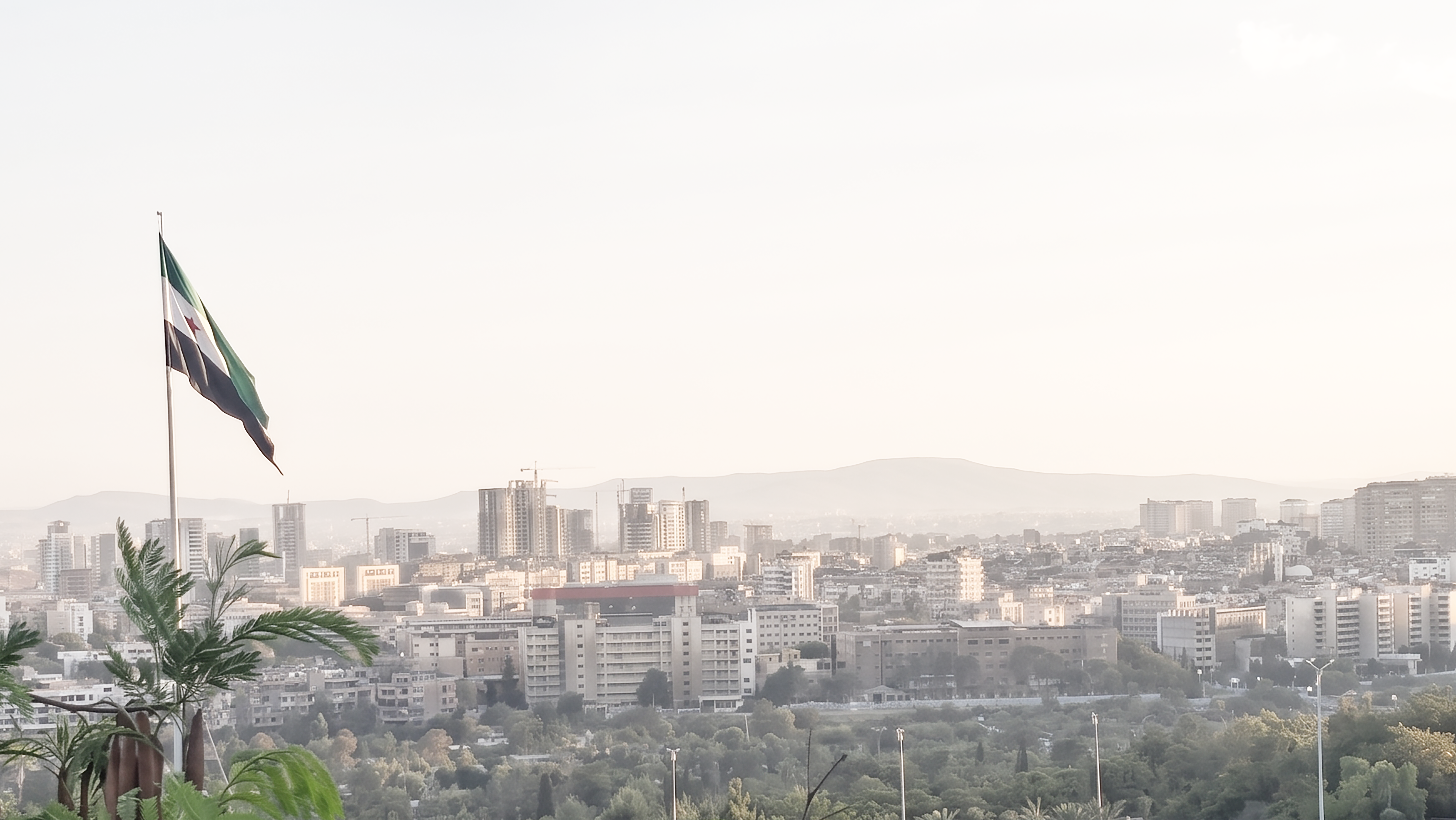
A view from Nairabein Park overlooking the high tower of Marota City. Photo by Rama Al-Samman, 2026.
The question of reconstruction in Syria dominates the discourse of the transitional period following the fall of the Assad regime in early December 2024, marking a new beginning of an end. While political stability remains fragmented, a surge of real estate development projects is being pushed in the name of ‘reconstruction’, bringing foreign capital and trade delegations into the country. Projects like Qasyoun Journey focus on tourism and commercial investment, while others like Abyat Hills, Sham View, and Yafour 963 are publicized as luxury housing with high sustainability standards and estimated at around $100,000 per unit.
Whether gated communities or residential towers, such structures were rare in the Syrian urban scene. This raises critical questions about whom ‘reconstruction’ is actually for and what kind of cities we want to inhabit.
In the shadow of luxury residences, internally displaced people are still living in deplorable conditions, and poor infrastructure is present in most cities and rural parts of the country. This is a spatial indicator that the middle class will decline even further than it already has. With salaries rising, Syria appears set to transform economically; however, basic human necessities remain expensive. Evaluating current reconstruction proposals means looking beyond the promise of modern amenities and examining their broader urban footprint and impact. In this case, gated communities reflect an outdated urban model that social scientists have warned against, as they fragment neighborhood connections and lead to societal friction.[1]

The current Syrian development reproduces a dynamic that David Harvey calls neoliberal urbanism, building on Henri Lefebvre’s ideas.[2] When capital accumulates and creates surplus in regional markets such as the Arabian Gulf, real estate becomes the primary engine for absorbing idle capital. Spatially, this manifests as urbanization. But it is, more precisely, a tool of speculative urbanism branded as ‘post-conflict reconstruction’ in the Syrian case.
Harvey expands on Marx to demonstrate how modern urbanization often functions as accumulation by dispossession. In transitional Syria, this dynamic is compounded by the unresolved legacy of Assad-era land seizures, where the current government treats historically confiscated properties as unencumbered state land rather than restoring them to their original owners. Consequently, land theft is enshrined and wealth is redistributed upwards, serving elites and foreign investors while excluding the urban poor.

When examining these projects, the language of sustainability, smart cities, and eco-friendly design is consistently promoted as a green cosmetic applied to buildings. Solar panels and green spaces, for example, are beneficial in isolation, yet raise a critical question: Does this kind of real estate development align with U.N. Sustainable Development Goals such as No Poverty (SDG 1), Sustainable Cities and Communities (SDG11), and Peace and Justice (SDG 16)?
While these goals are situated within the U.N. realm, the concept of sustainable development has evolved significantly over recent decades into the new ethos of urban planning. But the roots of sustainability can be traced back to Ibn Khaldun’s Muqaddimah, a fourteenth-century book addressing justice, good governance, human development, social cohesion, and environmental balance. Khaldun’s view on sustainability links environmental degradation to excessive consumption and emphasizes the principle of sufficiency.[3]
In the fragile transitional context of Syria, sustainability cannot be measured merely by green metrics whose real environmental impact remains negligible. Thinking of sustainability through the lens of sufficiency allows for equitable land distribution. When sustainable reconstruction is produced as a luxury product for the elite, however, it creates spatial and environmental injustice. Rich neighborhoods gain environmental protection and safety, while vulnerable communities are left with pollution, resource shortages, and infrastructure neglect.
Unfair — or ‘upward’ — distribution is rooted in deeper systemic problems, as marginalized communities are unrecognized, excluded from decision-making processes, and stripped of the basic resources needed to sustain their livelihoods.[4]
The fundamental flaw in environmentally friendly real estate approaches in Syria lies, I argue, in their failure to foresee the future, offering quick fixes that barely scratch the surface.
As sanctions lift and markets open, rapid short-term outcomes manifest in speculative real estate transactions, physical construction, and commercial expansion. Yet ecological systems operate on decadal timelines, and genuine ecological restoration requires long-term, systemic planning.
Thus, while Syria faces immense pressure to rebuild, environmental stability remains an indispensable component of food security, climate resilience, and human well-being.[5]

*
Climate and conflict in Syria
As Jason W. Moore argues in his world-ecology framework, modern urban capital demands quick profits, creating a clash between fast market cycles and incremental ecological recovery. From a world-ecological perspective, this occurs because capitalism converts urban space into a commodity and treats land as a disposable asset. In doing so, capitalism relies on what Moore describes as the ‘four cheaps’: cheap nature, cheap labor, cheap food, and cheap energy.[6]
Syria has witnessed a long destructive legacy of environmental manipulation, where nature is treated as a disposable commodity. Scholars argue that climate change intensified the pre-war Syrian drought in the late 2000s, causing significant rural-to-urban migration. This demographic shift, in turn, exacerbated socio-economic conditions that likely contributed to the outbreak of conflict.[7]
Today, speculative real estate pushes past vital natural boundaries, converting peri-urban agricultural lands into profitable real estate. Moreover, years of warfare have severely contaminated soil, air, and water systems, with 15 million tons of rubble threatening public health. The environmental cost of clearing rubble and electronic waste will cost between $167.6 and $269 million, as estimated by the World Bank.[8] Environmental vulnerability and climate change in Syria are neither a temporary phenomenon nor merely a future threat, but a structural force affecting the degradation of natural resources and urban ecologies alike.

Because environmental impacts require long-term monitoring, adaptive management, and community involvement, reconstruction efforts cannot be reduced to a static master plan, much less to a real estate venture. Despite a growing awareness of climate and environmental issues, current development frameworks consistently fail to address these long-term necessities.
Climate change adaptation can be considered a local practice, while mitigation requires governmental agreements to reduce greenhouse gas emissions globally. As Elinor Ostrom has demonstrated, communities are fully capable of self-governing shared ecological and spatial commons when provided with participatory institutions rather than top-down ones.[9] In other words, ecological adaptation is contextual and the case of transitional Syria, in particular, demands both investigation and experimentation.
*
Urban experimentation: Building resilience
Rather than presenting quick-fix solutions, this essay advocates for urban experimentation to pave the way toward genuine spatial and environmental sustainability. Urban experimentation centers on active, real-world learning by providing a structured framework to coordinate actors, resources, and tools, allowing cities to implement controlled interventions and evaluate their impact.[10]
Building on this concept, the Urban Living Lab (ULL) model emerges as a practical, operational tool. The ULL is an inclusive, user-centric ecosystem that operates in real-life contexts. It brings together diverse stakeholders, such as government bodies, academic researchers, and local communities, to co-design urban solutions and iteratively test their applications.[11]
Placing human users at the center of the ULL approach offers a direct antidote to an increasingly technocentric vision of sustainability. Rather than treating the green transition as a suite of smart sensors and solar panels, this approach anchors sustainability in human agency, local knowledge, and lived experience.
Although the ULL model originated in Northern Europe, it has recently been adapted to (and rearticulated from) different local institutional and socio-spatial realities in the Arab region and Mediterranean basin, specifically when addressing sustainability and low-carbon challenges. The project NATAE North African Transition to AgroEcology, for instance, includes seven living lab applications across diverse agro-socio-environmental zones, ranging from oases to peri-urban systems. Here, the ULL model facilitates participatory, farmer-researcher co-design.
Similarly, the TRANSCEND project implements living labs to address water scarcity across seven international river basins, including the Orontes River, a transboundary watershed shared between Syria, Türkiye, and Lebanon. The project incorporates ‘serious games’ as interactive tools for stakeholder engagement and scientific modeling to test decisions and observe outcomes iteratively. Due to regional political dynamics, the project currently focuses only on the Lebanese portion of the watershed. Expanding the project’s scope to encompass the entire Orontes River basin, as a collaborative initiative, would significantly enhance regional water governance and ecological resilience.
Furthermore, the living lab notion serves as a bridge between academic research and urban practice, as in the example of The Beirut Urban Lab, which integrates action-oriented research within university education schemes. Throughout the Syrian conflict and to the present day, numerous initiatives have similarly emerged to produce critical knowledge and share spatial expertise. The living lab model provides an inclusive, research-based hub for such approaches.
Through this model, every transitional Syrian city is understood as a complex living ecosystem. This means integrating agricultural and ecological systems within urban contexts, and recognizing the urban-ecology framework as critical to environmental resilience and justice. Urban ecology is an interdisciplinary field that examines the dynamic relationships between living organisms and their built environment.[12] The demand for climate adaptation in transitional Syria raises the stakes for localized experiments in urban ecology, moving beyond static, top-down policy to embed adaptive governance directly within local environments.

This means, first, addressing ecology in cities to explore the ecological processes within urban settings, in public squares or neighborhood commons for example. Equally, an ecology of cities encompasses dynamic interactions between social and ecological systems across the entire urban region. This includes watersheds, peri-urban agriculture, and biodiversity corridors that function as cross-jurisdictional systems and operate on long-term ecological timescales.
What does this mean for transitional Syria in particular? Mobilizing urban ecology for environmental justice in Syria begins by acknowledging that, after a decade of war, a country with no previous sustainable development framework or policies cannot suddenly engineer sustainability from the top down. Nor can climate resilience be imported through ready-made policies from foreign contexts.
As opposed to foreign investment schemes, which treat reconstruction as a mode of capital extraction, the living lab model offers a locally embedded, communally held incubation space, situated in a neighborhood or an open space where civil society, academics, and government institutions can test ideas and evaluate real-world possibilities specific to Syria’s transitional ecologies.
In regional perspective, establishing multiple living labs across the urban fabric produces what theorists call urban acupuncture, where small-scale changes positively impact the wider region. These localized micro-interventions generate a butterfly effect, providing the space for real ecological restoration and community co-creation across Syria.
Jana Ahmad is an architect and researcher based in Izmir. She holds a master’s degree in Urban Regeneration. Her work focuses on the intersection of climate change adaptation, urban governance, environmental justice, and the conservation of historic urban landscapes and cultural heritage in Syria and the Mediterranean basin. She is currently a research fellow at Ettijahat – Independent Culture, where her research focuses on environmental heritage, urban heritage governance, and cultural and environmental policies within urban living labs.
[1] S. Roitman, ‘Gated Communities: Definitions, Causes and Consequences’, Proceedings of the Institution of Civil Engineers – Urban Design and Planning 163, no. 1 (March 1, 2010): 31–38, https://doi.org/10.1680/udap.2010.163.1.31.
[2] David Harvey, ‘The Right to the City’, New Left Review 2, no. 53 (September 30, 2008): 23–40.
[3] Zaid Ahmad, Nobaya Ahmad, and Haslinda Abdullan, ‘Ibn Khaldun on Urban Planning: A Contemporary Reading of the Muqaddima’, Journal of Ibn Haldun Studies, Ibn Haldun University 1, no. 2 (July 15, 2016): 315–30.
[4] David Schlosberg, Defining Environmental Justice: Theories, Movements, and Nature (Oxford: Oxford University Press, 2007).
[5] Milia Esper, ‘Syria on the Brink of Water Scarcity: Climate Change, Drought, and Threats to Food Security’, Carnegie Endowment for International Peace (May 1, 2026): https://carnegieendowment.org/sada/2026/04/syria-on-the-brink-of-water-scarcity-climate-change-drought-and-threats-to-food-security.
[6] Jason W. Moore, Capitalism in the Web of Life: Ecology and the Accumulation of Capital (London: Verso, 2015).
[7] Jan Selby, Omar S. Dahi, Christiane Fröhlich, and Mike Hulme, ‘Climate Change and the Syrian Civil War Revisited’, Political Geography 60 (September 1, 2017): 232–44.
[8] Angham Daiyoub, ‘War and the Environment in Syria: An Interdisciplinary Approach to Biodiversity Conservation and Socio-Ecological Change’ (PhD diss., Autonomous University of Barcelona, 2025).
[9] Elinor Ostrom, Governing the Commons: The Evolution of Institutions for Collective Action (Cambridge: Cambridge University Press, 1990).
[10] James Evans, Andrew Karvonen, and Rob Raven, eds., The Experimental City (Routledge, 2016), https://doi.org/10.4324/9781315719825.
[11] Diana Chronéer, Anna Ståhlbröst, and Abdolrasoul Habibipour, ‘Urban Living Labs: Towards an Integrated Understanding of Their Key Components’, Technology Innovation Management Review 9, no. 3 (March 26, 2019): 50–62.
[12] ‘Exploring Urban Ecology: Understanding the City as an Ecosystem’, Environmental Studies Institute (October 17, 2025): https://evs.institute/urban-environment/urban-ecology-city-ecosystem/.